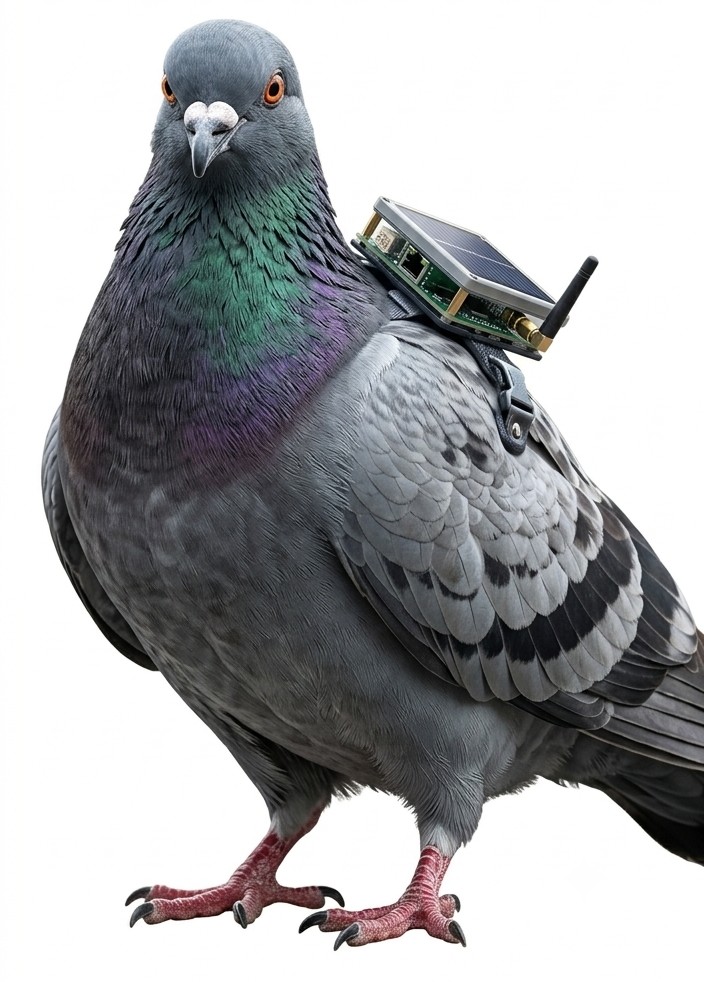
A pigeon wearing the PidgeyFLok solar Meshtastic tag
PidgeyFLok · deploying the urban sensor mesh

Your modern-day carrier pigeon.

For three thousand years they carried the message. We're bringing them back: the new-age carrier pigeon, with a job, a task and a tag lighter than breakfast. Scroll — he's got something on his back.

The Pidge

15 grams. Solar. Talks to the whole city.

A Meshtastic LoRa node on a leg-loop harness — under 5 % of the bird's weight. GNSS, temperature, humidity, pressure, air. It logs every minute and beacons every fifteen.

Homing

The bird comes home. So does the data.

Every evening at feeding time the tag docks at the loft and hands in the day. No cell plan. No airtime. No towers. Store-and-forward, the way pigeons always did it.

Squab to squadron

3,000 birds. 12 lofts. One city.

4.3 million rooftop readings a day: heat, air, wind, RF coverage, flock health. A denser network than any city has ever installed — for the price of the tags.

Return to work

Thousands of pigeons can have a duty again.

Bred by us, for a job. Then called pests. A fed, checked, sheltered flock goes back to work — and they love it. They sign up by the dozens and are, we think (or so we heard), pleased to work.
Solar patch · 0.4 Wcharges in flight and on the loft perch
LoRa 915 MHz · Meshtasticclient-mute beacon, open-source firmware
GNSS + climate + airtemp · humidity · pressure · PM2.5 option
Leg-loop harnessno glue, no collar, checked at every dock
scroll
PidgeyFlok · a Cat City program · by Artificial Mind Hive

Deploying the urban sensor mesh. One pigeon at a time.

Feral pigeons are a man-made bird that lands on every roof in the city. Put a 15-gram solar LoRa node on an owned club pigeon and you get a rooftop sensor and relay that never needs a cell plan, a tower, or a permit to dig. Three thousand of them cover a city for the price of one traffic light.

$15
per node, solar, no GPS needed
≤ 15 g
under 5 % of a pigeon's weight
3,000
rooftop nodes per big city
$0/mo
915 MHz LoRa, no plan, no tower
A city pigeon wearing a small solar LoRa backpack node with a short antenna
PidgeyFlok

Every rooftop a node.

A man-made bird that lands on every roof in the city, a 15-gram solar radio, and a city that suddenly has a $0/month mesh. This is how it gets built.

PidgeyFlok
01 · Pigeons

Pigeons carry it.

Owned club birds, a loft that feeds and checks them, a tag lighter than their breakfast. Three thousand per city, on the ledges cats cannot reach.

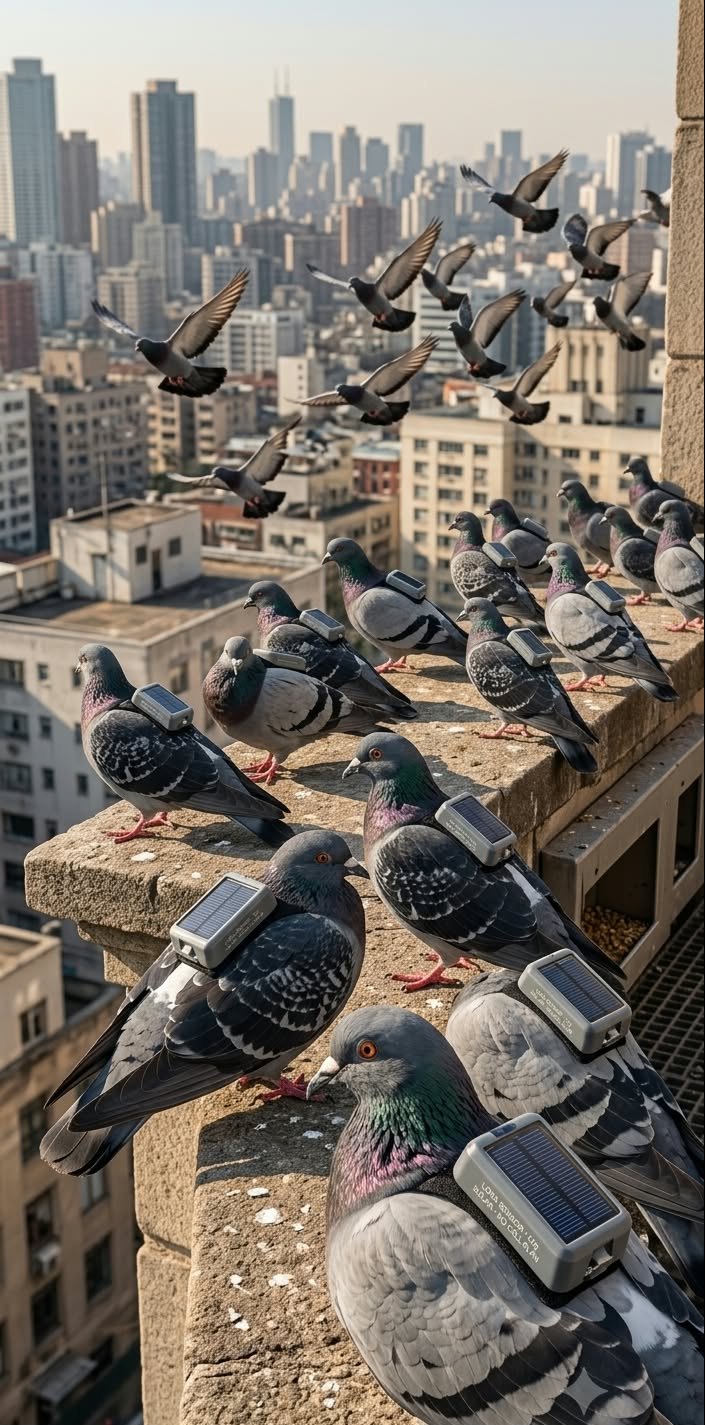
Tagged pigeons on a rooftop ledge
02 · Cats

Cats take the streets.

Tracked TNR colonies at street level. The city pays for this layer, because it is the one that ends the stray problem instead of managing it forever.

Street, roof and sky layers of the mesh
03 · People

People get free text.

A $15 pocket node and the app on a Lifeline phone: case workers, clinics, appointments, an SOS to the nearest outreach worker. No plan, no SIM, no cell coverage needed.

How it works ↓ The studies

The tagged pigeon
3,000 rooftop nodes per city · $0/month · no towers
How it works

Owned birds, a loft that feeds and checks them, and gateways on the chimneys.

1 · The birds

Club pigeons, never wild ones

Racing and homing pigeons from a local club, with the owner's consent. They roost in the same loft every night, so every node comes home to be checked, weighed and recharged. Wild birds are never touched.

2 · The tag

15 g, solar, leg-loop harness

LoRa radio, a solar patch, a 150 mAh cell, temperature / humidity / pressure, a 3-axis compass and motion sensor. Standard ornithology backpack mount: no glue, no collar. Beacons every 15-30 minutes; logs every minute; dumps the log at the loft.

3 · The gateways

Chimney receivers on Wi-Fi

A $10.90 Wi-Fi LoRa kit in a printed weatherproof box, screwed to a chimney or snapped onto a base plate. Fifty per city. Everything the birds hear lands on the map within seconds, on the roof's own Wi-Fi.

The mesh

Street, roof, sky: one free network the animals build for you.

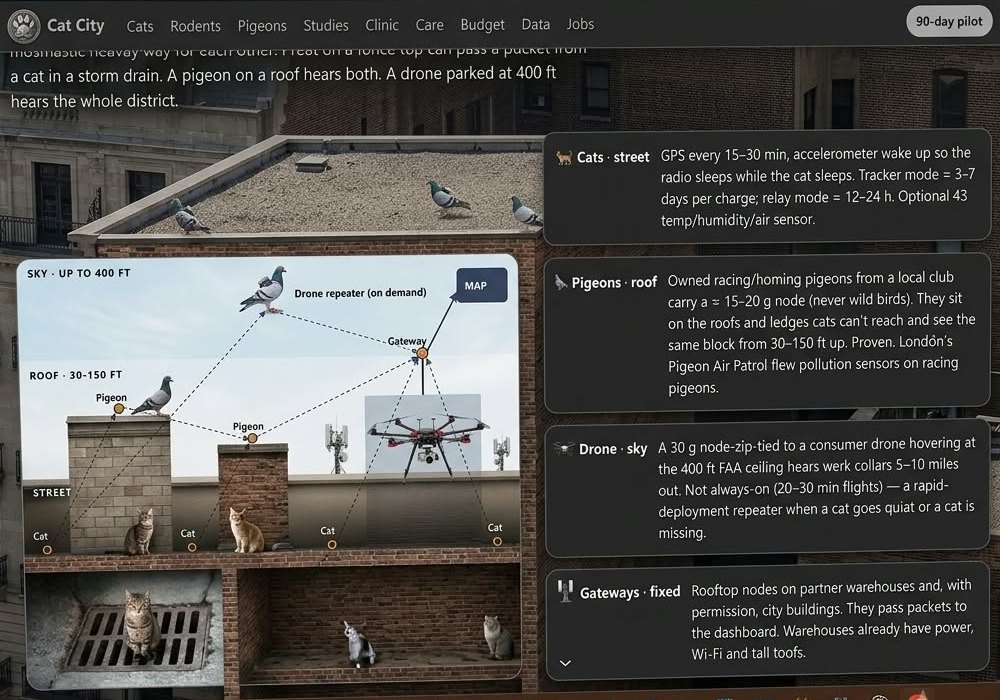
Every node relays for every other. A cat in a storm drain reaches a cat on a fence; a pigeon on the ledge hears both; a drone parked at 400 ft hears the whole district. Pigeons are the roof layer: the densest, cheapest, highest nodes a city can have, sitting exactly where cats cannot go and where the gateways already are.

1PigeonsRooftop relay blanket. $15 nodes.
2CatsTracked TNR colonies. The city pays for this layer.
3PetsPetfindr collars. Consumer revenue.
4PeopleFree text network on Lifeline phones + a $15 pocket node.
5ServicesAppointments, benefits, shelter beds, SOS to outreach. Pet food and basic vet care for unhoused and low-income pet owners, as part of the ongoing care program.
6The city4,000-point sensing; outage-proof messaging.
Tagged pigeons on a rooftop ledge with the city behind them, more birds landing
The rooftop layer. Concept render.
Numbers

Cities already spend eight figures a year on the animals. PidgeyFlok costs less than one percent of that.

Their own budgets: New York's shelter contract averages $53.7M a year; Miami-Dade Animal Services is $39.7M and holds 500,000 stray cats "steady"; Chicago spends $12.5-14.9M a year on rats and its own audit says the plan is unlikely to work. A full Cat City program with 3,000 pigeon nodes and 1,000 tracked cats is about $600,000 a year including a warehouse where we hold, train and neuter on site, priced to finish instead of continue; a city that lends an unused building pays $520,000.

Read both city studies →

Sources on the studies page: NYC Comptroller 2025, Miami-Dade FY23-24 adopted budget, Block Club Chicago / The Center Square, SF Chronicle, Pimentel 2005, Loss et al. 2013.

One year, one big city: their line vs. the whole program
NYC shelter contract / yr$53.7M Miami-Dade Animal Services$39.7M Chicago rodent control$14.9M SF Animal Care & Control$11.0M PidgeyFlok + Cat City$0.60M Blue = the city's own published budget line. Orange = us.
Diagram of the three layers: cats at street level, pigeons and gateways on roofs, a drone repeater in the sky
Sky · roof · street, one dashboard. Concept render.
The tag, and the science

What 3,000 birds carry, and what we learn from them.

  • Sensing: temperature at 30-150 ft above the street (the heat-island number nobody measures), humidity, pressure, and later air quality: four thousand points a city never had.
  • Relay: every bird forwards packets for cats, collars, pocket nodes and each other. Outage-proof by construction: nobody can switch off a pigeon.
  • Navigation science: pigeons steer by the sun, by smell and by a magnetic sense that is still not fully understood. Each tag carries a compass and motion sensor for about a dollar; thousands of birds logging heading and field, for years, is a dataset no lab has. We do not use magnetism as a radio (it is not one). We publish the first city-scale map of how they actually route.
  • Voice, later: we send the words, not the sound: a binary description of the speech, spoken by AI on the far end (your own voice profile later). Chunked, acknowledged, missing pieces re-requested, resumed when a node is back in range or a passing bird carries it across.
Pigeon clubs

Fly your birds on the mesh

You keep your birds and your loft. We supply the tags, the loft dock and the map. Your birds' data pays for their feed. Owned birds only, consent in writing, payload under 5 % of body weight.

Adopt

Every cat we find can go home

Kittens, friendly strays and owner surrenders are held at the hub, neutered, vaccinated, chipped and socialized, then adopted through the partner shelter. Working cats go to businesses. Adoption page →

Roof owners

Host a chimney node

A shoebox-sized weatherproof receiver on your chimney or wall, on your Wi-Fi, drawing less than a phone charger. You see the dashboard for your block. Warehouses, breweries and logistics yards first.

Cities & shelters

Start with the 90-day pilot

$25,000: twenty tracked cats, a hundred pigeon nodes, five gateways, one neighborhood, and a report the council can vote on. Then a city program priced to end the stray problem, not manage it forever. Have an unused building? Lend it as the hold-and-train warehouse and clinic room (vet students under a supervising DVM neuter on site; basic shots, flea and worm treatment for every animal) and the program price drops.

amh@artificialmindhive.com The scroll story → The full pigeon program →

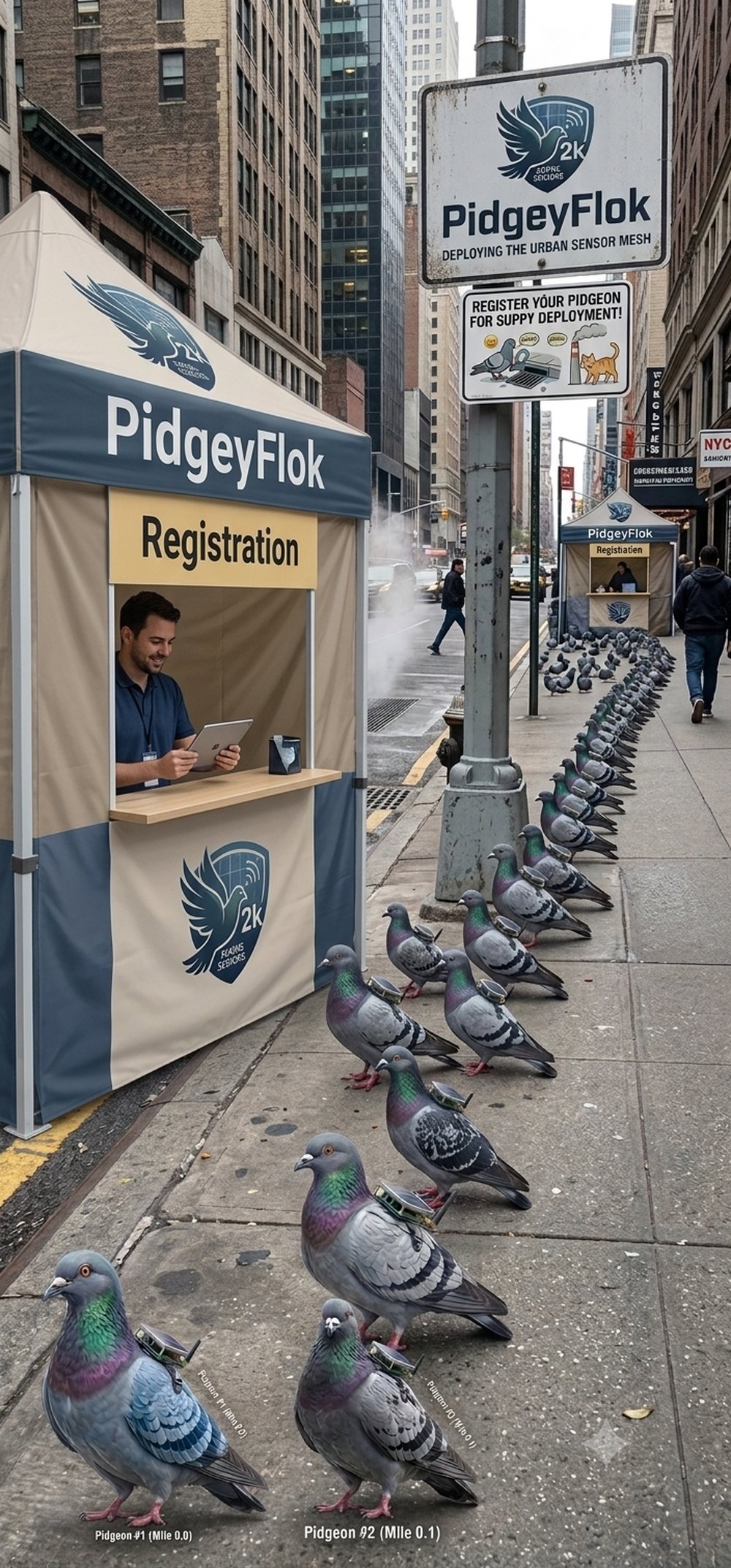
Concept art: pigeons wearing tags line up at a PidgeyFlok registration tent on a city sidewalk

Pigeons love it. It sells itself.

Registration day. Fed, checked, sheltered — that's a better deal than any bird in the city has today. The tag is the uniform.

Field notes from the flock

"Air mail" is not a metaphor anymore.PM2.5, CO₂, temperature and humidity, every minute, at roof height.
The loft is the only office where the staff show up early for lunch.Feed at the same time daily and the whole flock docks on schedule.
No towers, no plan, no roaming — just homing.Meshtastic LoRa plus store-and-forward. The tag carries the log home.
One loft per 20,000 residents. A town needs one. New York needs four hundred.The density rule that scales anywhere pigeons already live — which is everywhere.
DeerFlok: the herd draws its own map.Elk corridors, dusk deer crossings, ridge mountain lions — with the park's biologists and permits.
Lost on the trail? The search party is already overhead.Free trailhead tags; a bird passing over logs your last-heard point.

Case study · DeerFlok in a national park

Yosemite: a dozen or so deaths a year, a couple hundred search-and-rescue call-outs.Falls, water, exposure, lost hikers — most of them start as "overdue." Park figures vary by year; the shape doesn't.

Put ranger lofts at the trailheads and the valley stations. Free trailhead tags for hikers — grab one, clip it, drop it in the box at the end. Tag a few deer and bears with the park biologists under their permits. The flock passing overhead logs every beacon it hears and hands the log in at feeding time. A hiker who doesn't come back has a last-heard point on the map before the sun goes down; a bear working a campground loop is an alert, not a surprise.

LayerWhat it doesWho holds it
Trailhead tagsFree LoRa beacons; position every few minutes; days of battery; no phone signal neededRangers · visitor centers
Ranger flockHoming pigeons from valley lofts sweep the trails daily and carry the logs homePark + a local pigeon club
Ridgeline nodesFixed solar gateways where the flock doesn't fly; the mesh that works when cell doesn'tPark facilities · SAR
DeerFlok collarsDeer and bear movement, corridors, campground approachesPark biologists · state wildlife permits
DashboardLast-heard map, overdue list, wildlife alerts, one screen for SARPark SAR · dispatch

Read the TrailTag deep dive → Honest limits: pigeons fly by day and not in storms; coverage follows the lofts and ridge nodes. This is a search-starter and a deterrent, not a rescue guarantee. Park rules, wildlife permits and the flock's welfare rules all apply.

Deploying the urban sensor mesh.

Same tag on the cat at street level, the Pidge on the roof, the trailhead beacon in a hiker's pocket. One network, three couriers, one city that can finally see itself.

Start a pilot · one loft, 50 birds, 90 days
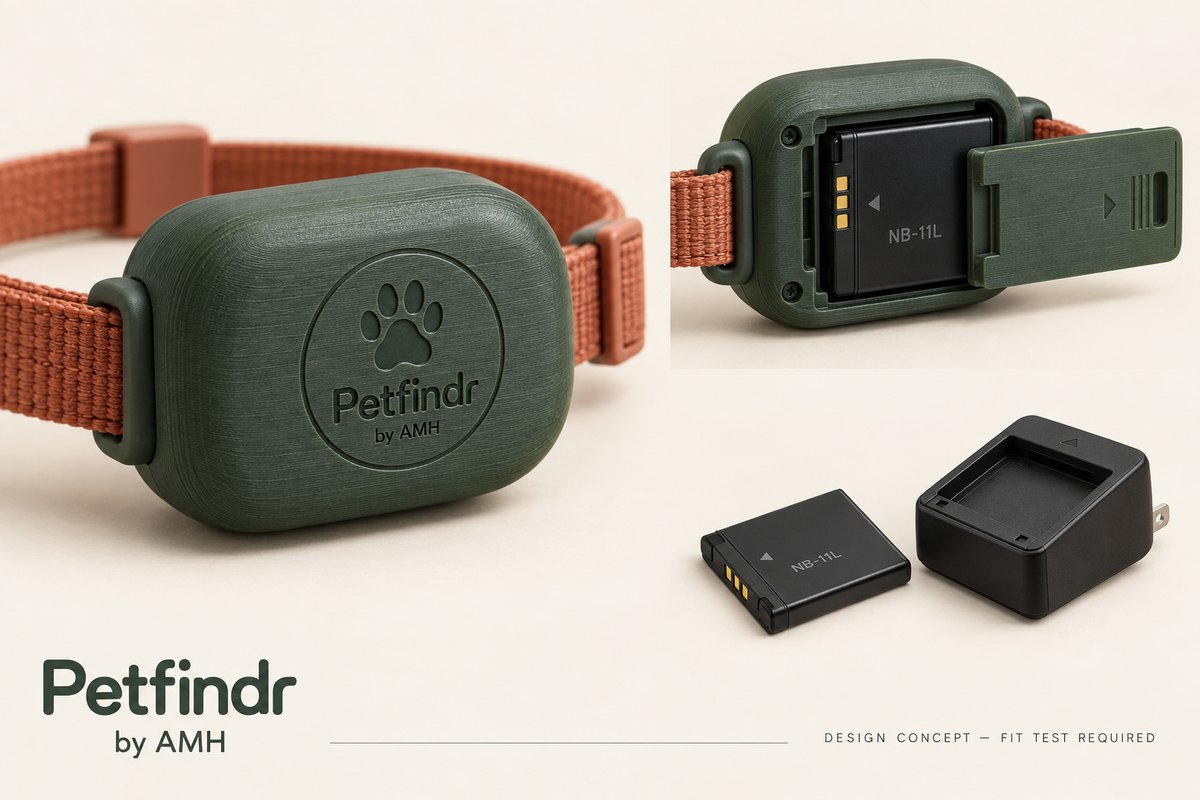
Petfindr collar tag by AMH — a green LoRa beacon on a rust-orange collar, battery door open, with the charging cradle
The pet layer

Petfindr: the pigeons listen for your pet too.

Every rooftop bird in the flock hears the same 915 MHz beacon a Petfindr collar sends. A lost dog three blocks over pings the ledge above it and lands on the map — no cell plan, no subscription, no tower. Pet owners pay for the tag; the city gets the mesh. And no — you don't have to tag these silly birds yourself. Your own dog sits for it. Mostly.

Check out Petfindr Little adventures. A way back home.

The Pidge, part by part

Off-the-shelf parts, open firmware. Nothing here has to be invented — the new part is the loft.

PartJobg
XIAO nRF52840 + Wio-SX1262Brain + LoRa radio, Meshtastic in client-mute6
L76K GNSSPosition fix when moving2
BME280 (+ optional PM2.5)Temp, humidity, pressure, air1
150 mAh cell + solar patchDays of power, topped up in flight and at the loft4
Shell + leg-loop harnessBetween the wings, under 5 % of body weight2
On the bird≈ 15

Why the math works

Range was never the problem — a rooftop LoRa node reaches other rooftops kilometres away. Airtime is the limit: thousands of birds can't all relay. So they don't. Birds are quiet loggers; lofts and rooftop gateways relay; the heavy data rides home on the bird and downloads at the dock. Flocks are sharded across LoRa frequency slots, one loft per slot.

Coverage comes from where the lofts sit: one per ~20,000 residents, 250 birds each, 2–3 km daily range, flocks overlapping at every border. Pigeons fly by day and not in storms — fixed nodes and the cats cover the night.

Flock gallery

The Pidge on a pigeon Registration day PidgeyFLok logo